Play-Based Learning vs Traditional Academic Preschools
Understanding Modern Preschool Education
Choosing the right preschool is one of the most important decisions parents make during their child’s early years. A strong preschool lays the foundation for future learning, confidence, creativity, and social development. Today, parents often compare two different approaches—play-based learning and traditional academic learning.
While both methods aim to prepare children for school, they differ in how children learn, explore, and develop essential life skills.
At Crayons Schools, we believe young children learn best through meaningful experiences that combine structured guidance with engaging, play-based activities. This balanced approach helps children enjoy learning while developing the skills needed for future academic success.
What Is Play-Based Learning?
Play-based learning is an educational approach where children develop knowledge and essential skills through games, exploration, storytelling, music, art, role play, and hands-on activities.
Instead of memorizing information, children actively participate in learning experiences that encourage curiosity and creativity.
Play-based learning helps children develop:
- Communication skills
- Creative thinking
- Problem-solving abilities
- Social interaction
- Emotional confidence
- Physical coordination
- Language development
- Independent thinking
At Crayons Schools, classrooms are designed to make learning enjoyable while encouraging children to discover new ideas through interactive activities.
What Is a Traditional Academic Preschool?
Traditional academic preschools generally place greater emphasis on classroom instruction, worksheets, repetition, and early reading and writing practice.
Children often spend more time:
- Learning alphabets
- Practicing numbers
- Writing exercises
- Memorization
- Classroom instruction
- Completing worksheets
Although these activities help develop academic skills, they may provide fewer opportunities for creative exploration and independent discovery during the early years.
Comparing Both Learning Approaches
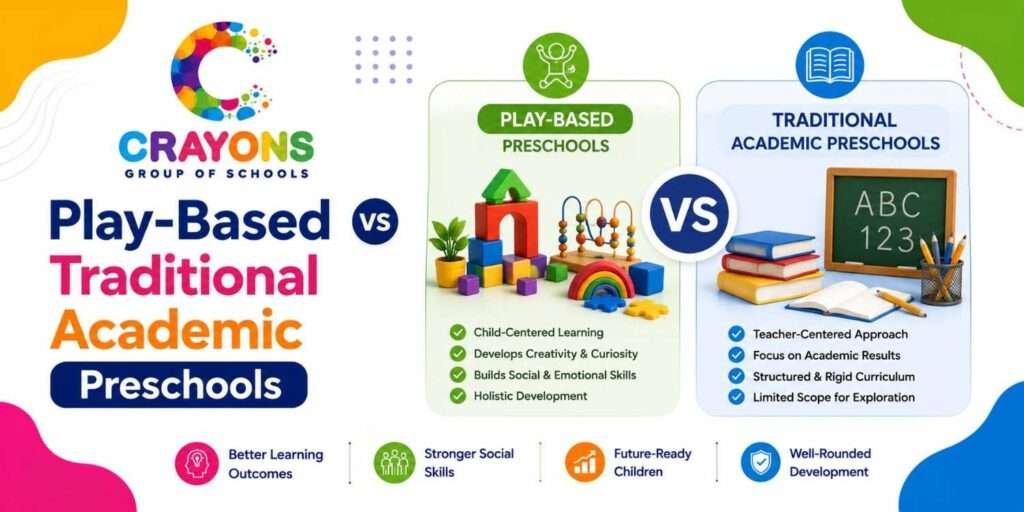
| Play-Based Learning | Traditional Academic Learning |
|---|---|
| Learning through activities | Learning through instruction |
| Encourages creativity | Focuses on memorization |
| Child-centered approach | Teacher-centered approach |
| Interactive classrooms | Structured classroom lessons |
| Develops life skills | Develops academic skills |
| Encourages exploration | Emphasizes repetition |
At Crayons Schools, we combine the strengths of structured learning with engaging activities so children enjoy learning while building a strong educational foundation.
Why Play Matters During Early Childhood
For young children, play is much more than entertainment—it is one of the most effective ways to learn.
Through play, children naturally develop important abilities such as:
- Asking questions
- Solving simple problems
- Sharing with others
- Taking turns
- Expressing emotions
- Building friendships
- Developing imagination
- Improving communication
These experiences prepare children not only for school but also for everyday life.
At Crayons Schools, every activity is carefully planned to support children’s overall development while making learning enjoyable.
Building Confidence Through Exploration
Children learn at different speeds. Some enjoy talking, while others prefer observing before participating.
Play-based learning allows every child to learn comfortably without unnecessary pressure.
Instead of worrying about making mistakes, children feel encouraged to:
- Explore new ideas
- Ask questions
- Try different activities
- Build self-confidence
- Learn independently
This positive learning environment helps children develop a lifelong love for learning.
At Crayons Schools, teachers guide children patiently while encouraging curiosity, creativity, and confidence.
Academic Learning Still Has an Important Role
Although play-based learning offers many advantages, academic readiness also remains important.
Children eventually need to develop:
| Academic Skill | Future Benefit |
|---|---|
| Letter recognition | Reading readiness |
| Number concepts | Early mathematics |
| Vocabulary | Better communication |
| Listening skills | Classroom participation |
| Fine motor skills | Writing preparation |
| Concentration | Academic success |
Rather than focusing only on academics or only on play, Crayons Schools follows a balanced learning approach that prepares children for primary school while supporting their emotional, physical, and social development.
Why Parents Prefer Balanced Learning
Modern parents increasingly recognize that children benefit most when education combines academics with meaningful experiences.
A balanced preschool program helps children:
- Learn with confidence
- Enjoy coming to school
- Build friendships
- Develop creativity
- Improve communication
- Strengthen problem-solving skills
- Become independent learners
- Prepare for future education
This balanced philosophy makes Crayons Schools a trusted choice for families looking for quality preschool education.
Why Crayons Schools Follows a Balanced Learning Approach
Every child is unique, and no single teaching method works for every learner. That is why Crayons Schools combines the best elements of play-based learning with age-appropriate academic activities. This balanced approach helps children enjoy learning while building a strong foundation for future education.
Children at Crayons Schools experience:
- Activity-based learning
- Storytelling sessions
- Early literacy activities
- Number recognition
- Music and movement
- Creative art and craft
- Hands-on classroom experiences
- Social and emotional learning
By balancing fun with structured learning, Crayons Schools prepares children for primary school without placing unnecessary pressure on them.
Preparing Children for Primary School
One of the biggest goals of preschool is to ensure children are ready for formal schooling. School readiness is about much more than knowing letters and numbers. It also includes confidence, communication, curiosity, and the ability to interact with others.
| School Readiness Skill | How Crayons Schools Supports It |
|---|---|
| Language Development | Storytelling and conversations |
| Early Mathematics | Fun counting and activity games |
| Fine Motor Skills | Drawing, coloring, and craft |
| Social Skills | Group activities and teamwork |
| Confidence | Classroom participation |
| Problem Solving | Interactive learning experiences |
At Crayons Schools, children develop these essential skills naturally through engaging classroom activities.
The Role of Teachers in Early Learning
A caring teacher can make a significant difference in a child’s preschool journey. Young children need encouragement, patience, and positive guidance as they explore the world around them.
The educators at Crayons Schools focus on:
- Creating a safe learning environment
- Encouraging curiosity
- Supporting individual learning styles
- Building confidence
- Promoting creativity
- Developing communication skills
This nurturing approach helps every child feel valued and motivated to learn.
Why Parent Involvement Matters
Parents play an important role in reinforcing classroom learning at home. When parents and teachers work together, children receive consistent guidance that strengthens their overall development.
Parents can support their children by:
- Reading together every day
- Encouraging imaginative play
- Talking about school experiences
- Celebrating small achievements
- Maintaining healthy routines
- Limiting unnecessary screen time
At Crayons Schools, strong parent-school communication ensures children receive continuous support both at home and in the classroom.
Why Parents Choose Crayons Schools
Families trust Crayons Schools because the preschool focuses on developing confident, curious, and happy learners through a balanced educational approach.
Some of the key advantages include:
- Safe and child-friendly campus
- Activity-based curriculum
- Experienced and caring teachers
- Holistic child development
- Interactive classrooms
- Individual attention
- Creative learning environment
- Strong parent communication
- Focus on life skills
- Preparation for future academic success
These qualities make Crayons Schools an excellent choice for children beginning their educational journey.
Which Preschool Approach Is Best?
Choosing between play-based and traditional academic learning does not have to be difficult. The most effective preschool is one that combines structured academics with meaningful activities that encourage exploration and creativity.
A balanced approach helps children:
- Enjoy learning
- Build confidence
- Develop communication skills
- Improve concentration
- Strengthen creativity
- Become independent learners
- Prepare for formal schooling
- Build lifelong learning habits
This philosophy is at the heart of every learning experience at Crayons Schools.
Frequently Asked Questions
What is play-based learning?
Play-based learning is an educational approach where children learn through activities, games, storytelling, exploration, music, and hands-on experiences that promote overall development.
Is play-based learning better than traditional academic learning?
Both methods have benefits. A balanced approach that combines engaging activities with age-appropriate academics, like the one followed at Crayons Schools, supports well-rounded child development.
Does Crayons Schools teach academics?
Yes. Crayons Schools introduces literacy, numeracy, language, and other academic concepts in an age-appropriate and engaging way while ensuring learning remains enjoyable.
How does Crayons Schools prepare children for primary school?
Through activity-based learning, communication development, early literacy, number concepts, creativity, social interaction, and confidence-building experiences.
Why should parents choose Crayons Schools?
Crayons Schools offers a safe environment, experienced educators, balanced curriculum, interactive learning, holistic child development, and strong parent-school partnerships that help children succeed academically and personally.
Conclusion
Choosing the right preschool is about finding an environment where children feel safe, happy, and inspired to learn. While traditional academic methods help introduce foundational concepts, young children also need opportunities to explore, create, ask questions, and develop essential life skills through meaningful experiences. A balanced learning approach ensures children are prepared not only for primary school but also for lifelong success.
At Crayons Schools, we combine play-based learning with age-appropriate academics to create an engaging educational experience that supports every aspect of a child’s development. Our experienced teachers, interactive classrooms, child-friendly environment, and holistic curriculum help children build confidence, communication skills, creativity, and a love for learning. If you are looking for a preschool that nurtures both academic readiness and overall development, Crayons Schools provides the perfect foundation for your child’s bright future.