
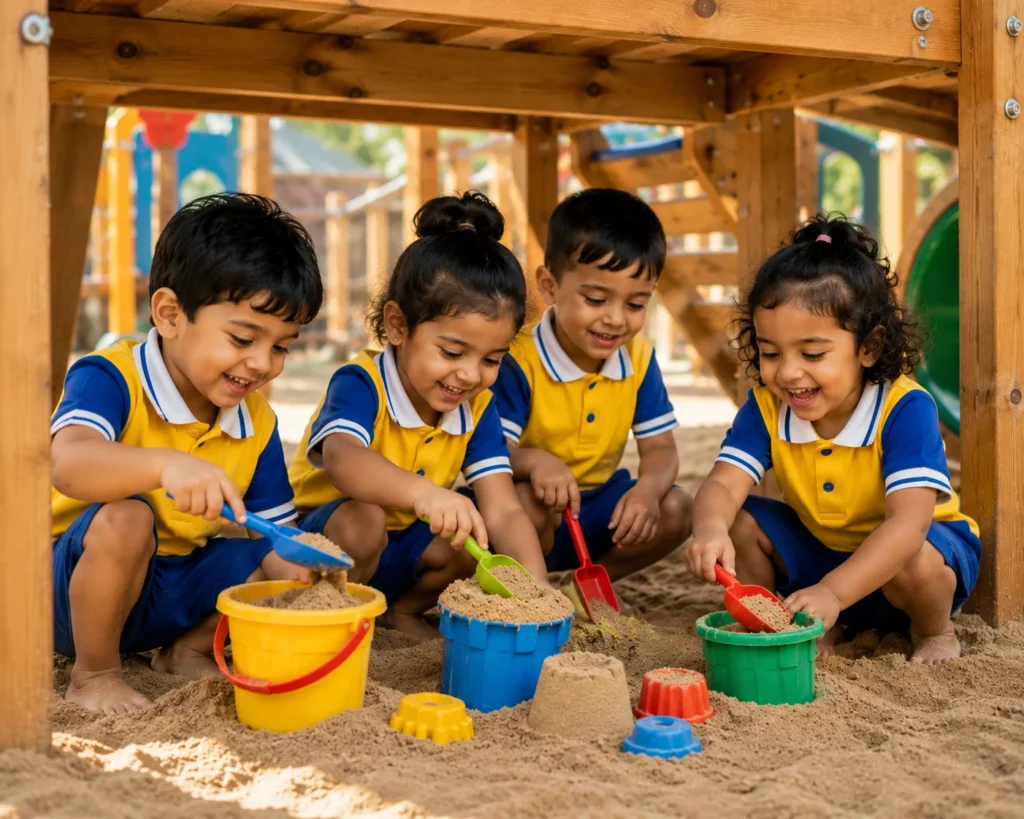
Watching the Growth Chart on Our Wall
It lives on the inside of our kitchen door, where nobody important will ever see it.
A strip of pencil lines, each with a date and a name in my handwriting, climbing from just above the skirting board to somewhere around my daughter’s shoulder. Some lines are straight. Some tilt, because she was wriggling. One has a small crossed-out mistake beside it, where I wrote the wrong year and my husband corrected me with a sigh.
I did not plan it as anything meaningful. On her first birthday, I pressed her back against the door frame, balanced a book on her head and made a quick mark. It seemed like the sort of thing parents do. Years later, I know that it has become one of the most precious objects in our home, and I did not even buy it.
The Ritual of the Birthday Line
Every year, on the morning of her birthday, before cake, before presents, before anyone is fully awake, we measure.
She stands barefoot against the door. She holds her breath, as though that will make her taller. She insists on standing on tiptoe, and I insist that she does not, and we have the same cheerful argument every single year. I place the book flat on her head, mark the line and write her age beside it.
Then she steps away, turns around and studies the new line with the grave concentration of a scientist reading data.
“I grew this much,” she says, holding her finger and thumb apart.
I always agree, even when the gap is wildly exaggerated. Because she is right in a way that has nothing to do with centimetres.
What the Wall Remembers
I stand in front of that chart sometimes, when the house is quiet, and read it from the bottom up.
The first line is so low it looks like a mistake. It is almost at my knee. I remember her on that day, a round-cheeked baby in a yellow dress, clutching my finger because she could barely stand without help. The line beside it says 1 year, and underneath, in my hand: wobbly but brave.
By the third line, she was a toddler, running through the house in a nappy, shouting a single word that meant everything: “Mine!” By the fourth, she had started preschool, and I remember measuring her that morning with a lump in my throat, thinking about the small backpack waiting by the door.
The chart does not record any of that. It records only height. But my memory fills in the rest, line by line, like a story told in pencil.
The Growth You Cannot Measure
It took me years to understand what that chart was not showing me.
A pencil line can tell you that a child has grown two inches. It cannot tell you that she has learned to say sorry without being asked. It cannot record the first time she comforted a crying friend, or the afternoon she learned to tie her own shoes, or the day she stopped looking back at the gate.
Every one of those moments is growth. Each is as real as the inches on the wall, and in many ways, more important. But we have no ruler for them.
Parents measure height easily, because height is visible and simple. The deeper growth, in confidence, kindness, curiosity and courage, happens quietly, in the spaces between the lines. And a great deal of it happens in rooms we are not present in.
What Preschool Added to the Wall
When my daughter started preschool, I felt that I was losing sight of her growth. For the first three years, I had watched every inch of it. Now, for several hours a day, she was growing in a world I could not see.
What I did not expect was how much her teachers at Crayons Schools would help me see it again.
They noticed things. Small, specific things, shared with me at pickup or in short messages. “She helped a child who was crying today.” “She tried a new food without being asked.” “She raised her hand for the first time.” Each observation was a mark on a different kind of wall, one I could not draw myself.
Her teacher once said something that I wrote on a sticky note and kept. “We do not only measure what is easy to measure. We try to notice what is quietly changing.”
That sentence has stayed with me ever since.
The Day She Stood Taller Without Standing Straighter
The most memorable moment on that invisible chart came in her second term.
She was five. A new child had joined the class, a small, silent boy who clung to the edge of the room and would not speak. At pickup one afternoon, her teacher took me aside.
“I wanted to share something,” she said. “Today, your daughter sat beside him, took out her favourite crayons and said, ‘You can use the red one. It is my best.’ He did not answer. But he picked it up.”
I stared at her. My daughter, who at three had refused to share a single toy, had offered her favourite crayon to a stranger.
That night, I did not measure her. There was no need. I looked at her sleeping face and knew, quietly and completely, that she had grown more that week than any pencil line could ever record.
Why Growth Charts Matter
I have come to love that chart for reasons I never expected.
It slows time. A single line, drawn on a single morning, becomes a pause in a year that otherwise rushes past. The ritual forces me to stop, look at my child and notice how much she has changed.
It makes growth visible. Day to day, children seem to grow imperceptibly. The chart makes the invisible tangible. It is the only way I have ever caught time in the act.
It turns growth into a story. Every line has a date, an age, sometimes a note. Together, they form a narrative of a childhood, told in her own height.
It teaches her something too. My daughter now understands that growth is gradual, and that it happens to everyone. When she was frustrated about being “too small” for a ride at a fair, she stopped, looked at me and said, “I just have to wait for my next line.”
That is a lovely lesson, and one I did not plan to teach.
A Few Ideas If You Would Like to Start Your Own
If this story has made you want to begin a chart of your own, here are a few things that worked for us.
Choose a quiet place. A door frame, the inside of a cupboard, a spare strip of wall. Somewhere you will see it often but guests will not.
Use a pencil. Pens are permanent, and pencils are gentle. You can always trace over a line later if you want to preserve it.
Pick a regular date. A birthday works beautifully. A start-of-school day works too. The ritual matters more than the date.
Add small notes. A line without context loses its power. Write a phrase beside it: what she loved that year, a funny thing she said, her favourite word.
Include the whole family. Measure siblings, cousins, even yourself once. Children love seeing the chart as a family tradition rather than a test.
Take photographs. A yearly photograph of your child beside the chart gives you a second record, and a lovely thing to compare.
Do not worry about perfection. Tilted lines are fine. Crossed-out years are fine. Imperfection is what makes it yours.
Keep the wall if you move. If you can, take a photo of the whole thing, or have the strip of wood removed and framed. Many families do.
The Hardest Line to Draw
There is a line I dread, though I know it will come.
One day, my daughter will stand against that door, and the book on her head will rest at the same height as the line I made for myself, years ago, when I measured myself for fun. And one day after that, she will be taller than I am.
I know I will stand in that kitchen, pencil in hand, with a smile I will have to arrange carefully on my face. I know I will say something light and funny. And I know I will feel, deep in my chest, the mingled pride and ache of a parent whose child has outgrown the very wall that measured her.
But I also know what I will say to her afterwards. I will tell her that the chart was never really about height. It was about the mornings we stood there together, a mother and a daughter, pausing to notice time.
Building Places Where Growth Is Seen
I think about that chart whenever I think about what a good preschool does.
A school does not only teach children. It notices them. It sees the quiet, invisible lines that parents often miss: the first words spoken to a new friend, the first time a hesitant child tries something difficult, the first moment of real confidence. A good school makes those lines visible and shares them with the people who love the child.
That is why the people who build preschool franchises are doing something quietly important. They are creating places where children are seen as individuals, where growth is noticed as carefully as height is measured, and where every small change is treated as meaningful. A Crayons Schools franchise is not only a business. It is a community’s way of keeping a very good, very patient chart.
The Pencil Lines Are Still There
Last week, I stood in front of the door again. The newest line was only a month old, a fresh grey stroke near her shoulder. Beneath it, in my handwriting, I had written: 8 years. Brave. Kind. Terrible at handstands.
She came up beside me, looked at it and laughed. “You wrote terrible at handstands.”
“It is true.”
“It is rude.”
“It is also true,” I said, and she leaned against my arm, and we stood there for a moment, two people reading a story written in pencil on a kitchen door.
Behind us, the afternoon light slid across the floor. In front of us, the lines climbed upward, quiet and patient, proof that time had passed and that we had been there for all of it.
Give Your Child a Place Where Every Kind of Growth Is Seen
At Crayons Schools, we believe that the most important growth cannot be measured with a ruler, and that every child deserves teachers who notice it. If you are searching for a preschool where your child’s confidence, kindness and curiosity are nurtured and celebrated, we would love to welcome your family. Book a campus visit today, meet our teachers and see how we help every child grow, one small, brave line at a time.
And if you have ever dreamed of building a place where growth is truly seen, a Crayons Schools franchise could be the way to bring that vision to your own community. With proven systems and genuine franchise support, you do not have to build it alone. Enquire about franchise opportunities today, and begin building a school where every child is noticed, and every small victory is marked.